

Current challenges of international transport
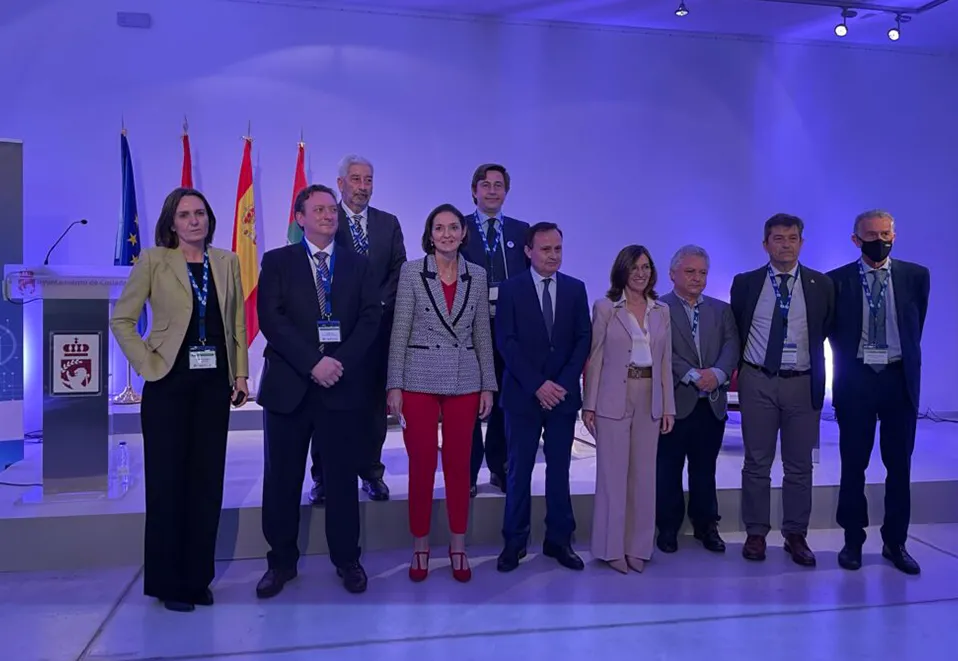
On March 9th, a conference took place in Coslada, at the Antonio López Cultural Center, about the CURRENT CHALLENGES OF INTERNATIONAL TRANSPORT: INTERMODALITY AND LOGISTIC INFRASTRUCTURES.
The conference was opened with a presentation by Salvador Galve, Dean of the Official College of Industrial Engineers of Aragón and La Rioja. His speech focused on the European Alliance for the development of RAIL CORRIDORS to structure the Iberian Peninsula and its connection with Europe.
Next, the members of the first debate panel, “The Railway Operators,” were introduced, featuring Alejandro Huergo, Area Manager of Marketing at Renfe; Miguel Ángel Fañanás, Business Development Manager at Medway; Rodrigo Jiménez, Director of Operational Safety at Go Transport; and Idoia Galindo, member of the Executive Committee at Transfesa Logistics.
The second panel discussed Maritime Ports, with participation from Lluis Paris, Head of Automotive at the Port of Barcelona; Andima Ormaetxer, Operations Director at the Port of Bilbao; and Juan José Aguilar, Head of Operations and Intermodality at the Port of Algeciras.


Burgos Logistics Activities Zone
In the third panel, among other interventions from different speakers, the Managing Director of the Transport Center of Burgos, S.A. and Multimodal Logistics Castilla y León, S.A., Gonzalo Ansótegui, presented the BURGOS LOGISTIC ACTIVITIES AREA, formed by the TRANSPORT CENTER OF BURGOS, the DRY PORT, and the BURGOS AIRPORT. During the debate, it was discussed that it cannot be generalized, but there are too many dry ports in the northwest region, as they are located in Pancorbo, Júndiz, Miranda de Ebro, Burgos, Agoncillo, and others are planned or under development in Valladolid, Segovia, Salamanca, etc. In other words, it is not clear that there will be enough containers for all of them. However, the conclusion was that there will be a natural selection, and in the end, only those well-managed with sufficient critical mass will survive.
There was also a discussion about who should be responsible for the location and hierarchy of dry ports. The speakers agreed that the classification established in the 2030 freight plan seems reasonable, as it divides them into strategic ones at the national level, special ones based on autonomous communities, and the rest, which will depend on private initiative.
Regarding the question of how to enhance rail transport, the answer is not easy. From Burgos, it was pointed out that investment in railway infrastructure is fundamental. Not only in rail highways but also, and primarily, in tracks, sidings, and rail terminals, adapting them to current traffic. It was also mentioned that it is essential to connect industry with rail transport through rail branches when there is a sufficient critical mass. The industry needs to be connected with rail transport.
The idea was also raised that companies setting up railway corridors with regular trains should receive financial support during their initial stages until they reach a critical mass of containers that will allow them to maintain the planned regular frequencies.
In the fourth debate panel, moderated by Ramón García, director of CEL, Iñaki Echeverría, Head of Country Spain at Höegh Autoliners, S.L., Juan Carlos Abellán, Managing Director of IC MARITIME SERVICE, S.L., and Juan Pablo Lázaro, Executive President of Sending, participated.
Iñaki Echeverría pointed out that the excessive zeal and sanctions from the Spanish Tax Agency (AEAT) on customs matters will make shipping companies choose other ports besides Spanish ones to dispatch their goods.
His intervention also addressed the different types of fuels that current ships can use, and the option for ships to come with the possibility of using various types of fuels so they can use the most suitable one at any given time.
The session was closed by Dª Maria Reyes Maroto, Minister of Industry, Commerce, and Consumer Affairs of the Spanish Government, who spoke to the attendees about the future of intermodality, digitalization, the development of the 2030 Freight Plan, and the new Railway Highway from the Port of Algeciras to Zaragoza/Barcelona, which is already under construction.