


The Dry Port will handle close to 150,000 tons of goods per year with the multi-client train to Valencia
The City Council is allocating €600,000 to promote this connection until its use by private companies becomes widespread / “Logistics flows have picked up considerably since the beginning of the year,” says Juan Carlos Martín, manager of the Burgos Transport Center.
Source: El Correo de Burgos
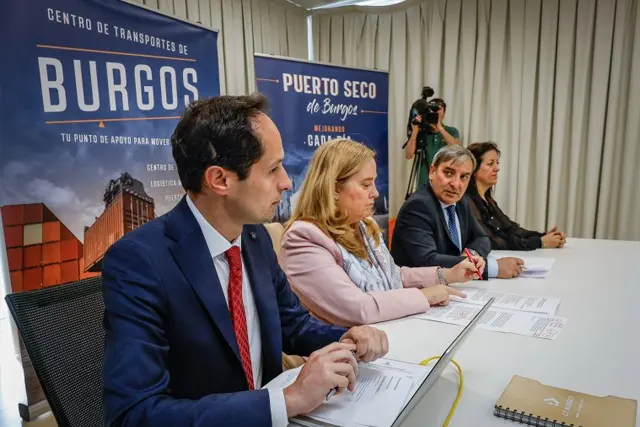
The manager of the Burgos Transport Center, Juan Carlos Martín, alongside the city’s mayor, Cristina Ayala, and the Regional Minister for Mobility and Digital Transformation of the Regional Government of Castile and León, José Luis Sanz Merino. TOMÁS ALONSO
The Dry Port could once again approach 150,000 tons of goods per year following the incorporation of the multi-client train to Valencia. That, at least, is the hope of the manager of the Burgos Transport Center (Cetabsa), Juan Carlos Martín, after noting the notable reactivation of “logistics flows” since the beginning of the year, following a period of decline.
Specifically, he estimates that 40,000 tons of cargo were moved in the first months of 2025, which he expects to increase significantly in the near future with the aforementioned connection, to reach the average annual figure with which the financial years closed in times of prosperity.
“Last year we were very far from that figure, but we believe that this year we will be close to reaching it,” said Martín, explaining that they currently operate between two and three trains per week, in addition to those that supply the Kronospan facilities, with which Cetabsa collaborates until, once the direct access is completed and the appropriate licenses are obtained, it can operate directly from the factory via the railway branch line built for this purpose.
The Burgos City Council is committed to ensuring that the manager’s growth estimates become a reality. Hence the inclusion in the budget amendment approved in May on a provisional basis of a €600,000 allocation to cover the start-up of the aforementioned multi-client train to Valencia, a formula that allows the cargo of different companies to be transported together on the same trip, which implies economic advantages for users. The municipal intention is to collaborate in the initial phase so that, “once companies become aware of it, they sign up to the initiative and the City Council can withdraw,” explained the city’s mayor, Cristina Ayala.
Both the mayor and the head of the Transport Center made these statements in the presence of the Regional Minister of Mobility and Digital Transformation of the Regional Government of Castile and León, José Luis Sanz Merino, minutes before the opening of the conference on the Logistical Potential of Burgos, held at the Cetabsa headquarters.
In this context, Ayala referred to the commercialization of the Cetabsa expansion area, which is currently under development. She recalled that the entity’s board of directors, of which the City Council is a member, had already decided months ago on a two-pronged approach: “One of the methods will be the traditional one, that is, attracting customers through word of mouth, and this will be complemented by the work of a company that will help us in this area.”
He indicated that the government team is also studying ways to improve access to the Transport Center, although the solution will not be immediate. “It is a project that must be addressed, because it is true that the entrance is complicated, especially for trucks. It is an issue that we have on our agenda and that we want to address at some point,” he said, thanking Sanz Merino for his presence and willingness to help.
Ability to “continue growing” and be a benchmark
For his part, the Minister for Mobility highlighted Burgos’ key role in achieving the Regional Government’s ambitious goal of “making Castile and León a national and international logistics hub.” The steps to be taken to achieve this, he added, are set out in “a framework that we intend to launch by 2030.” He thus emphasized the capacity of both the region and the province in particular to “continue growing,” for which, he assumed, it is necessary to “relaunch the Dry Port together.”
In this regard, after mentioning the local and regional investment of 3.3 million euros that covered the expansion of the Transport Center and the 7 million euros that made possible the exemplary public-private partnership to connect the Villafría railway terminal with Kronospan, Sanz Merino urged the central government to join forces to provide the necessary impetus to the sector in the community and especially in Burgos, the area with the largest amount of logistics land (almost 400,000 square meters). “If we have your help, we will be able to offer companies a competitiveness that is currently hampered by high costs,” he said.
The minister considered the modernization of infrastructure to be crucial in order to maximize potential and offer companies the best conditions, and called on the executive to speed up the definition and implementation of the Atlantic Corridor Master Plan for Castile and León: “We are not asking for more than other communities, but we will not accept less either,” he added.
For a reopening of the “minimum” Direct
The Minister of Mobility took advantage of his visit to Burgos to call for the opening of the Direct Train. “We are not seeking a full reopening, which would obviously require investment figures that may not be within the reach of the Ministry of Transport at this time, but there are intermediate options,” he said. He provided data from the Regional Government of Castile and León on the cost of a minimum start-up that would, above all, guarantee freight service and, consequently, “the backbone of rail transport.” “Our estimates are around 400 million euros for the entire operation. I don’t know if they are accurate or if they need to be reformulated from a technical point of view,” he acknowledged, but they are far from the 1.4 billion euros previously proposed by the government official responsible for the sector, Óscar Puente.
While waiting for the new feasibility study to be completed (which should be finished by the middle of this year), Sanz Merino asked that “they not propose a maximum figure that would make the plan currently being drafted unfeasible.” According to the representative of the regional government, the challenge is rather the opposite and involves “lowering” those expectations in pursuit of the long-awaited reopening, which will also allow the capital of Burgos to become a recognized logistics hub within the Atlantic Corridor.